
Biofilm, biofouling and intelligent monitoring
Biofilm as a natural process
Biofilm formation is a natural biological process. In water systems, microorganisms attach to surfaces and start producing a protective slimy matrix. This matrix, often described as extracellular polymeric substances (xPS), helps bacteria settle, grow and to survive changing environmental conditions.
At an early stage, biofilm may be almost invisible to operators. The water can still look clear, while surface-related changes are already developing inside pipes, heat exchangers, cooling circuits, filters, membranes or other wetted components. Over time, these biological layers can influence flow, heat transfer, water quality, corrosion behaviour and system reliability.
For technical water systems, the challenge is not that biofilm exists. The challenge is knowing when biological activity is becoming relevant for operation, maintenance or risk management.
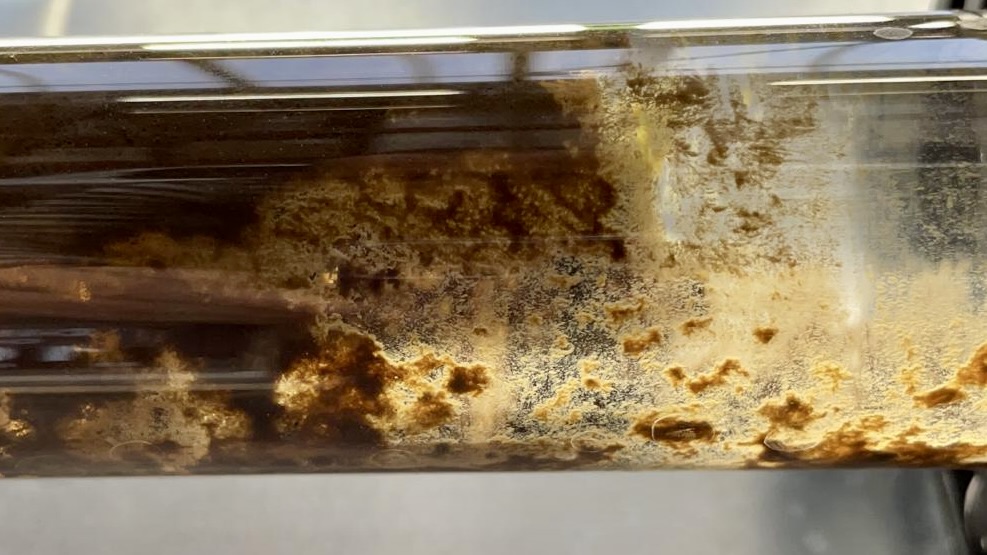
Biofilm in technical water systems
Industrial and process-water systems create ideal conditions for biofilm growth. Water, nutrients, temperature, flow differences and large internal surface areas all contribute to settlement and growth.
Biofilm-related issues can occur in many systems, including cooling towers, drinking-water installations, food and beverage process water, pharmaceutical water systems, reverse-osmosis systems, aquaculture, swimming pools and industrial process-water loops.
Once a biofilm becomes established, it can become harder to remove. The protective layer may reduce the effectiveness of treatment, shield microorganisms from biocides and create local conditions that differ from the bulk water. This is why early insight is valuable: operators need to understand whether a system is stable, changing or moving toward a condition that requires action.
From visible fouling to early system change
Traditional biofouling control is often reactive. Operators may rely on periodic sampling, laboratory analysis, pressure drop, flow reduction, visual inspection, cleaning intervals or operational complaints. These methods are useful, but they often show the problem after it has already developed.
A modern monitoring approach should help identify relevant changes earlier. Not every fluctuation is a problem. Water systems are dynamic, and optical signals can change because of bulk-water effects, suspended particles, colour changes, air bubbles, flow variation or temporary disturbance.
The important question for our optical measure system is therefore not simply: “Is there less light?” The better question is: “Is there a persistent surface-related change that cannot be fully explained by the behaviour of the bulk water alone?”
The Biofilm Monitor approach
We developed an innovative, wireless, sensor-based Biofilm Monitor (BFM), which has now been operating for 2.5 years without any hardware or software issues. The BFM is a prototype that is ready for industrial design. It uses the Bio Intelligent Monitoring System (BIMS) platform, which we developed to support operators. BIMS is designed to help operators, engineers and biologists understand changes in water system behaviour over time.
The system combines four optical channels with controlled measurement geometries. These channels do not act as one simple light threshold. Instead, the data is interpreted as a differential optical model. The system compares measurement behaviour, separates bulk-water influence from additional surface-related attenuation and follows the trend over time.
BIMS does not claim to directly detect biofilm. Instead, it identifies persistent additional differential attenuation that cannot be fully explained by bulk-water attenuation alone. This formulation is important because the system supports interpretation of biological and surface-related change without overstating what the measurement directly proves.
Physics-based interpretation
The alarm status in BIMS is determined by a physics-based interpretation layer. The system looks at model behaviour, trend, persistence and confidence. This makes the result more robust than a single raw threshold or one isolated measurement point.
In practical terms, the platform helps answer questions such as:
- Is the system optically stable?
- Is the bulk water changing?
- Is there additional attenuation that appears to be surface-related?
- Is the change temporary, or does it persist?
- Is the trend moving toward a warning condition?
Does the operator need to act now, watch the system or continue normal operation?
This creates a practical bridge between raw measurement data and operational decision-making.
AI-supported explanation, not AI-based alarms
BIMS uses AI to explain the physics-engine result in clear human language. AI helps translate complex measurement behaviour into practical interpretation for operators, engineers and biologists. However, AI does not determine the alarm status. The alarm logic remains based on validated model behaviour, measurement trends and persistence. This keeps the system transparent, explainable and suitable for technical environments where decisions must be traceable.
Continuous monitoring and timeline context
Biofilm-related processes are rarely understood from a single measurement. What matters is how the system changes over time. BIMS therefore combines continuous monitoring with historical trend analysis, timeline events and notifications. Operators can see whether a condition is stable, improving or deteriorating. Events such as cleaning, dosing, maintenance, calibration or process changes can be placed in context with the measurement data.
This makes it easier to evaluate whether an intervention worked, whether a system returned to a stable condition or whether further investigation is needed.
Practical early-warning support
The purpose of our BFM is not to replace biological expertise. It is to provide earlier and clearer insight into system behaviour, so that expertise can be used at the right moment. With continuous monitoring, operators can move from reactive maintenance toward condition-based decision-making. Instead of waiting for visible fouling, reduced performance or operational disruption, the system helps identify meaningful change before it becomes a larger problem.
This supports better timing of inspection, cleaning, dosing optimisation and maintenance planning.
Designed for critical water systems
Our BFM is designed for water systems where stability, hygiene, efficiency and reliability matter. Typical applications include:
- Cooling towers and cooling-water systems
- Industrial process-water installations
- Potable-water systems
- Food and beverage water systems
- Pharmaceutical and high-purity water systems
- Reverse-osmosis and membrane systems
- Lifestock and aquaculture/fish-farming systems
- Swimming pools and recreational water systems
In each of these environments, the value lies in understanding change early, interpreting it correctly and giving operators a clear answer:
Is the system healthy, should we watch it, or is action recommended?
A smarter way to understand biofilm risk
Biofilm formation is complex, and no single measurement can explain every biological process inside a water system. Our BFM is built around that reality. By combining four-channel optical measurement, differential modelling, trend-aware interpretation, timeline context and AI-supported explanation, BIMS provides a practical and transparent monitoring layer for modern water systems. It helps users understand additional differential attenuation, follow system-health development and take action based on clear, explainable information.
Further information or a demonstration can be requested through the contact form.